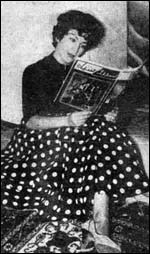
فروغ فرخ زاد| Forog Farrokhzad
کانون هواداران شادروان: فروغ فرخزادفروغ فرخ زاد| Forog Farrokhzad
کانون هواداران شادروان: فروغ فرخزادآﯾﻪ ھﺎی زﻣﯿﻨﯽ

آن روزھﺎ

آﻓﺘﺎب ﻣﯽ ﺷﻮد

ﻣﻦ از ﺗﻮ ﻣﯿﻤﺮدم

Forough Farrokhzad
Forough Farrokhzad The most famous woman in the history of Persian literature Forough Farrokhzad Forough Farrokhzad was born on January 5, 1935 in Tehran into a middle class family of seven children (the third of seven children). She attended public schools through the ninth grade, thereafter graduating from junior high school at the age of fifteen; she transferred to Kamalolmolk Technical School, where she studied dressmaking and painting. In 1951 at sixteen Forough married her cousin Parviz Shapour over the objections of families mainly because of Shapour's age. And a year later Forough's first and only son "Kamyar" was born. Frough separated from Parviz Shapour in 1954. Forough relinquished her son to her ex-husband's family in order to pursue her calling in poetry and independent life style. In 1955 Forough's first collection, titled Asir (The Captive), contains forty-four poems was published. And in September that year she suffered a nervous breakdown and was taken to a psychiatric clinic. In July 1956 Forough left Iran for the first time on a nine-months trip to Europe. In this year her second volume of verse, containing twenty-five short lyrics, called Divar (The Wall), was published, dedicated to her former husband. In 1958 Forough's third collection Esian (Rebellion), appeared and securely established her as promising yet notorious poet. Forough's relationship with the controversial writer and cinematographer Ebrahim Golestan began and remained important in the poet's personal life until her death. Forough Farrokhzad as film maker In 1962 she made a documentary movie about a leper's colony, titled "The House Is Black". The movie was acclaimed internationally and won several prizes. In 1963 UNESCO produced a thirty minutes movie about Forough. Also Bernardo Bertolucci came to Iran to Interview her and decided to produce a fifteen minutes movie about the poet's life. In 1964 Forough's fourth poetry collection, Tavallodi Digar (Another Birth), contained thirty-five poems which the poet had composed over a period of nearly six years was published. In 1965 Forough's fifth collection of verse called "Let Us Believe In The Beginning Of The Cold Season" is in print and was published after her death. On Monday February 14, 1967 Forough visited her mother, who later recalled their conversation over lunch as the nicest that they ever had. From her mother's home, on the way back, with Forough driving, at the intersection of Marvdasht and Loqumanoddowleh Streets in Darrus, her jeep station wagon swerved to avoid an oncoming vehicle and struck a wall. Thrown from her car, at the height of her creativity and barely thirty-two Forough Farrokhzad died of head injuries. She was buried beneath the falling snow in the Zahiro-Doleh in Tehran. She clearly voices her feelings in the mid-1950s about conventional marriage, the plight of women in Iran, and her own situation as a wife and mother no longer able to live a conventional life in such poems as "The Captive", "The Wedding Band", "Call to Arms", and "To My Sister". As a divorcee poet in Tehran, Farrokhzad attracted much attention and considerable disapproval. She had several short lived relationships with men, and "The Sin" describes one of them.